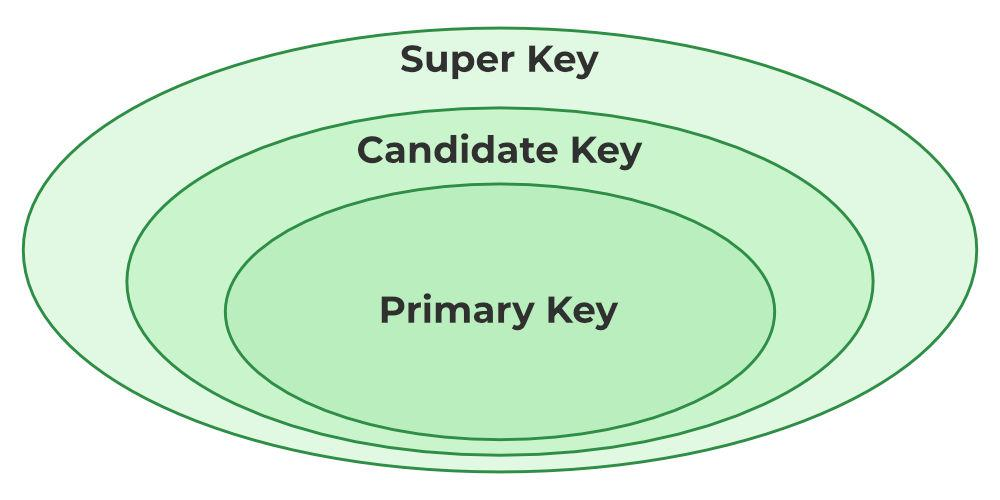
Types of Keys:
- Primary Key (PK): Unique tuple ident; no nulls, no duplicates.
- Foreign Key (FK): Links two tables; refs PK in parent tbl, ensures referential integrity.
- Candidate Key: All potential PKs; unique, irreducible.
- Alternate Key: Candidate keys not chosen as PK.
- Composite Key: Combines multiple attrs to form a unique id.
- Super Key: Attr set uniquely idents tuples; may contain extra attrs.
Primary Key:
- Props: Ensures uniqueness, non-null values, supports indexing.
- Example:
StudentIDinStudenttbl uniquely identifies each student.
Foreign Key:
- Props: Refs PK of parent tbl, enforces relationships, can allow nulls/duplicates (optional).
- Example:
CourseIDinEnrollmenttbl refsCourseIDinCoursestbl to maintain valid relationships.
Simple v/s Composite Keys`
| Aspect | Simple Key | Composite Key |
|---|---|---|
| Definition | A single attribute uniquely identifies tuples. | Combines multiple attributes to uniquely identify tuples. |
| Complexity | Simpler to define, manage, and index. | More complex due to multiple attributes. |
| Example | EmployeeID in an Employee table. | {OrderID, ProductID} in an OrderDetails table. |
| Key Size | Single column/field. | Multiple columns/fields. |
| Indexing | Efficient and straightforward. | Slower indexing due to combined attributes. |
| Query Performance | Faster as only one attribute is involved. | Slower for large datasets due to joins on multiple attributes. |
| Uniqueness | Ensures tuple uniqueness with one attribute. | Ensures tuple uniqueness through a combination of attributes. |
| Usability in FK | Easier to reference as FK in another table. | More difficult to reference as FK; requires all attributes in combination. |
| Use Case | When a single attribute is sufficient for identification. | When no single attribute can uniquely identify tuples. |
| Storage Requirement | Requires less storage. | Requires more storage due to multiple attributes. |