1. Definition
-
ER Model (Entity-Relationship Model)
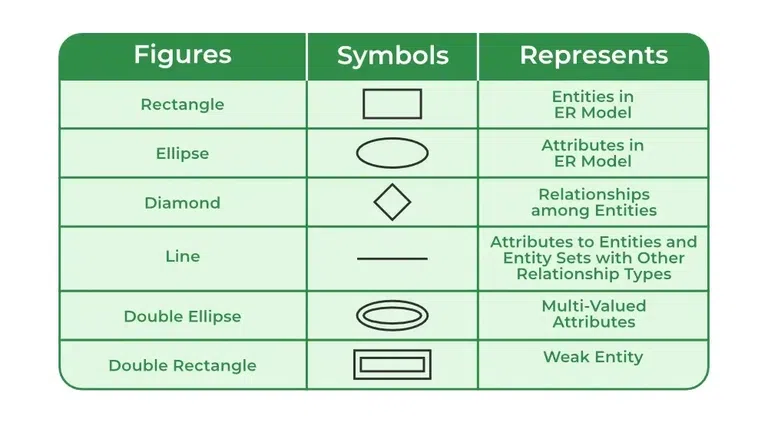
- A high-level conceptual model that represents data using entities, attributes, and relationships.
- Focuses on designing a database by abstracting real-world scenarios.
-
Relational Model
- A logical model that organizes data into tables (relations) with rows (tuples) and columns (attributes).
- Focuses on storing and manipulating data.
2. Comparison
| Aspect | ER Model | Relational Model |
|---|---|---|
| Representation | Graphical with entities, relationships, and attributes. | Tabular with relations, tuples, and attributes. |
| Purpose | Used for database design and conceptual understanding. | Used for database implementation and querying. |
| Level of Abstraction | High-level conceptual view. | Logical and physical view. |
| Primary Elements | Entities, relationships, and attributes. | Tables, rows (tuples), and columns (attributes). |
| Data Integrity | Constraints like cardinality and participation. | Constraints like primary, foreign, and unique keys. |
| Relationships | Directly represented as edges in the diagram. | Indirectly represented using foreign keys. |
3. Advantages
ER Model
- Visualization: Easy to understand and design databases with diagrams.
- Abstraction: Provides a clear, high-level abstraction of data.
- Flexibility: Helps identify entities, attributes, and relationships intuitively.
Relational Model
- Simplicity: Tabular format is easy to understand and use.
- Query Optimization: Supported by SQL, with powerful data manipulation and querying capabilities.
- Normalization: Reduces redundancy and ensures data consistency.
4. Disadvantages
ER Model
- Complexity: Becomes complex for large systems with many entities and relationships.
- Lacks Implementation Details: Needs to be converted into a relational or another logical model for actual use.
Relational Model
- Design Dependency: Heavily relies on a good initial design (based on ER models).
- Scalability Issues: Large and complex relationships may require additional joins, impacting performance.
5. Use Cases
-
ER Model:
- Designing databases from scratch.
- Modeling real-world scenarios conceptually.
-
Relational Model:
- Storing, querying, and manipulating structured data.
- Implementing databases in RDBMS like MySQL, PostgreSQL, or Oracle.
ER Diagram